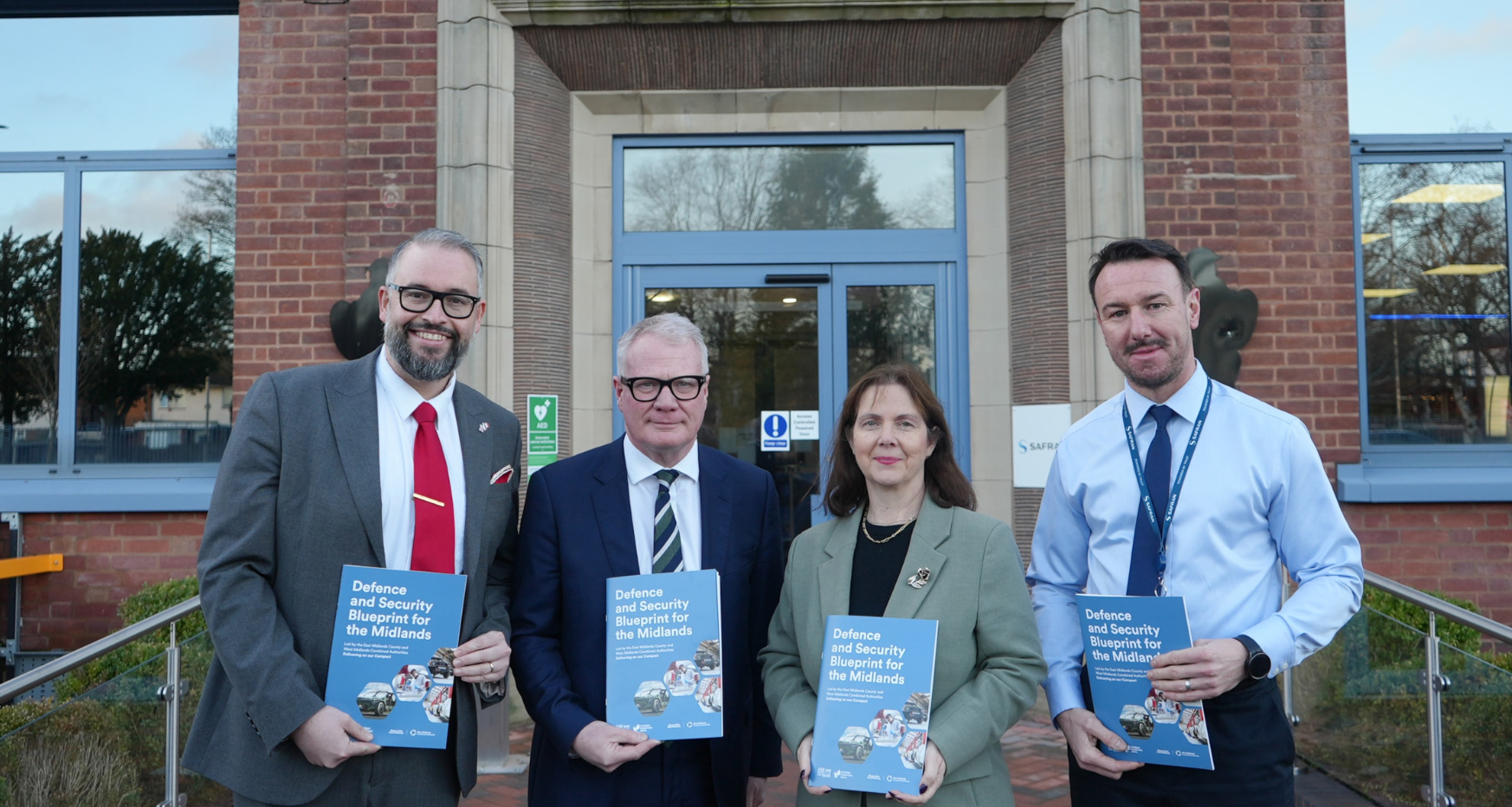
Midlands Mayors unite to secure new defence plan
Midlands Mayors Richard Parker and Claire Ward are urging regional businesses to seize new defence industry opportunities as government spending on national security increases.
Defence is already a major part of the Midlands economy. Both Mayors have made supporting the sector central to their growth plans.
With global military and cyber threats at their highest level in decades, the Mayors are bringing together senior industry leaders. Their aim is to help Midlands firms secure millions of pounds in new government investment for UK-based companies.
The new Midlands Defence and Security Industry Council will promote Midlands manufacturers and innovators, strengthening national security while creating economic growth and well-paid local jobs.
The Council is the first of its kind in the region. It forms part of the Defence and Security Blueprint for the Midlands, which aims to boost defence capabilities across advanced manufacturing, engineering and digital businesses.
The plan includes upskilling the workforce and creating new career routes for graduates and apprentices. It also offers targeted support to help more SMEs win government contracts or enter defence supply chains.
The blueprint will also support innovative firms developing modern defence technologies. These include advanced composite materials, next-generation cyber security, and secure communications systems.
The Mayors launched the plan during a visit to Safran in Wolverhampton. The company employs 1,500 people making mission-critical flight control and actuation systems for commercial and military aircraft.
Safran recently completed a $1.8 billion investment to expand its UK and global operations. It is one of around 1,000 defence and related companies across the West and East Midlands, employing 50,000 people — 10 per cent of the UK defence workforce.
The government’s Defence and Security Industrial Strategy recognises the potential of the West and East Midlands to play an even bigger role in countering global and cyber threats.
Securing new investment and jobs in these sectors is also been identified as a critical economic priority of the Compact agreement signed by the two Mayors last year on behalf of the West Midlands and East Midlands combined authorities that they lead.
Together, the two regions have a £133bn economy made up of almost 150,000 businesses, and a combined population of 5.2 million people.
Richard Parker, Mayor of the West Midlands, said: “Defence is of course about keeping our country and our way of life safe, but it also presents some important economic opportunities.
“Our region’s manufacturing sector already plays a vital role in national security, from the armoured vehicles and aerospace parts that we make in Birmingham and the Black Country, to our automotive expertise in Coventry and Solihull.
“This blueprint is our plan to build on the world-class skills, cutting-edge research capability and engineering know-how we have in our region. It will futureproof our economy against times of uncertainty and create real opportunities for people in every part of the Midlands.”
Claire Ward, Mayor of the East Midlands, said: “The East Midlands has a proud industrial heritage and a growing reputation for innovation, engineering excellence and digital capability. This plan recognises that our region is not only vital to the UK’s national security, but also central to delivering high-quality jobs, investment and long-term economic growth for all our communities.
“Mayor Richard Parker and I know that by working closely with businesses, universities and government, we can help more local firms secure defence contracts, scale up new technologies and build strong supply chains rooted locally. This is about backing our people with the skills they need, creating clear pathways for apprentices and graduates, and ensuring that increased defence spending benefits people in the towns and cities of the Midlands.”
“Through our partnership with the West Midlands and the Defence and Security Blueprint, the East Midlands is ready to play an even bigger role in keeping the country safe while building a stronger, fairer economy for the future.”
Matthew Badhams, Safran Actuation’s associate director for global defense systems, said: “As the UK’s third-largest employer in civil aerospace and a key regional employer in the Midlands, we’re proud to launch the Defence and Security Blueprint for the Midlands at our Wolverhampton site, alongside partners Richard Parker and Claire Ward.
“Safran Electronics & Defense is a market leader on several of the UK’s most critical military platforms and a trusted partner to the Ministry of Defence. We are fully prepared to support the Government’s Defence Industrial Strategy and share its ambition to make defence a powerful driver of economic growth.
“This regional strategy goes beyond enhancing defence capabilities; it focuses on long-term, sustainable growth. In Wolverhampton, it is closely aligned with the Green Innovation Corridor, which brings together advanced manufacturing, clean growth, skills development, and connectivity.
“By linking defence investment with the Green Innovation Corridor, we aim to create new career pathways for young people, strengthen high-value supply chains, and ensure the defence sector grows in a productive, resilient, and environmentally sustainable manner – benefitting Wolverhampton, the Midlands, and the UK as a whole.”
The region’s Defence and Security Blueprint also sets out plans to maximise the legacy from next year’s Invictus Games, which will be held in Birmingham, by promoting the region as a global leader in defence medicine, rehabilitation innovation, and inclusive veteran support.
There are 15,000 regular armed forces personnel either living or currently based at Ministry of Defence sites here.
Both the West and East Midlands combined authorities are among nearly 15,000 proud signatories of the Armed Forces Covenant across the Midlands, committing to promoting inclusive employment and helping veterans thrive in civilian life.